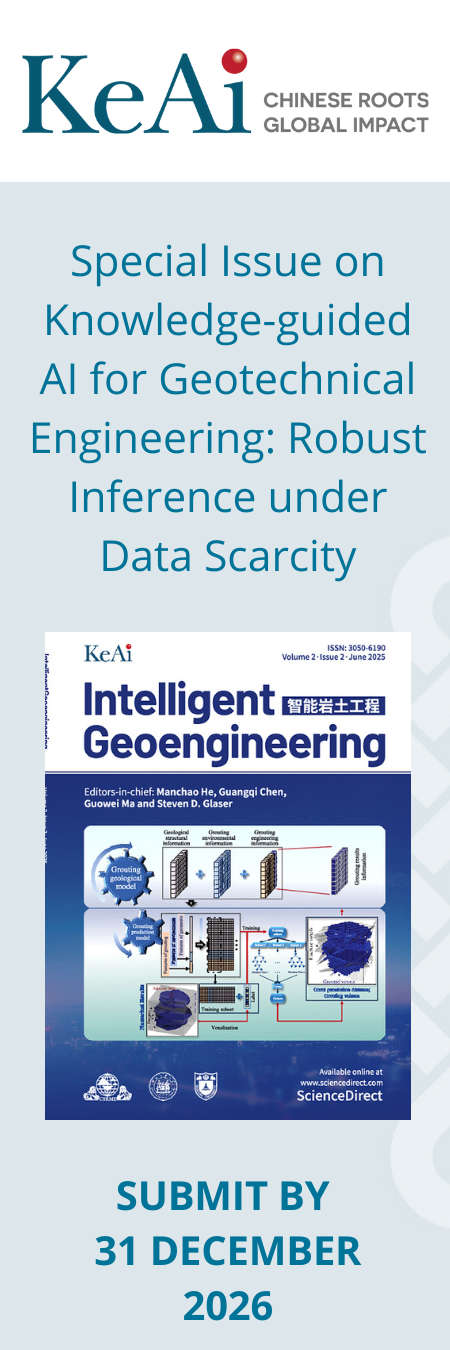
Intelligent Geoengineering

Intelligent Geoengineering
"Intelligent Geoengineering" aims to be a leading platform for distributing advanced research at the intersection of geotechnical engineering and intelligent technologies. The journal focuses on foste...
"Intelligent Geoengineering" aims to be a leading platform for distributing advanced research at the intersection of geotechnical engineering and intelligent technologies. The journal focuses on fostering innovation by integrating Artificial Intelligence (AI), big data analytics, and the Internet of Things (IoT) into geotechnical practices, promoting sustainable and eco-friendly methodologies. It encourages submissions that advance theoretical knowledge and demonstrate practical solutions to geoengineering problems, promoting interdisciplinary collaboration to enhance the global impact of its publications. The journal fosters community engagement, providing a vibrant platform for exchanging ideas and discussing the incorporation of emerging technologies in geotechnical engineering. The journal also aims to establish a dynamic forum where geotechnical researchers, practitioners, and policymakers can exchange ideas and discuss innovative practices on the integration of emerging technologies.
Topics of particular interest include, but are not limited to:
IoT and smart sensors for geotechnical monitoring and testing.
Big data and AI applications in georisk analysis and decision-making.
Machine learning for soil and rock behavior prediction.
Innovative forecasting and early warning for geotechnical stability.
Eco-friendly geomaterials and geotechnologies.
Climate change impacts and mitigation in geoengineering.
Case studies on intelligent geoengineering
Society affiliation
Chinese Society for Rock Mechanics & Engineering (CSRME) was formally established on March 5, 1985 with the approval of the National Economic System Reform Commission of the People's Republic of China and the China Association for Science and Technology (CAST). It runs as an academic mass organization for serving scientific and technological wo...
Chinese Society for Rock Mechanics & Engineering (CSRME) was formally established on March 5, 1985 with the approval of the National Economic System Reform Commission of the People's Republic of China and the China Association for Science and Technology (CAST). It runs as an academic mass organization for serving scientific and technological workers who are engaged in rock mechanics and geotechnical engineering across the country. The CSRME currently has 58 branches, 21 local societies, 96 group members and more than 170,000 individual members, covering water conservancy and hydropower, coal and oil, geology and mining, environmental protection, national defense engineering. It is well-known domestically and internationally as an important academic organization in the field of rock mechanics and geotechnical engineering with extensive influence across industries, departments and disciplines.
For more detailed information, please visit http://www.csrme.com/.
Call for Papers
Special Issue on Intelligent Rock Mechanics for Major Engineering Projects: Theory, Methods, and Applications
Submission deadline: 30 December 2026
Special Issue on Knowledge-guided AI for Geotechnical Engineering: Robust Inference under Data Scarcity
Submission deadline: December 31, 2026
News