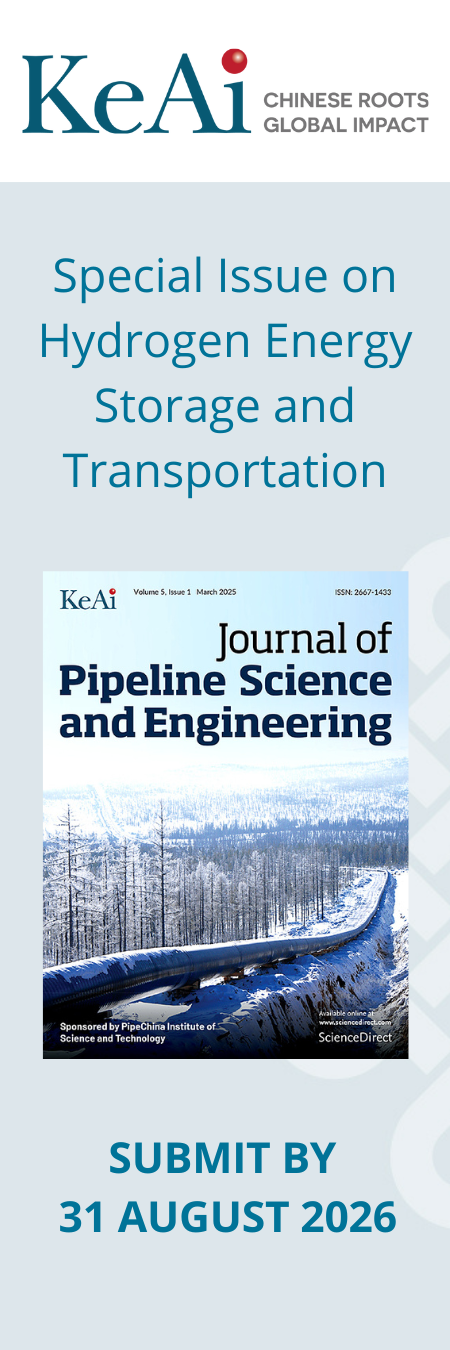
Journal of Pipeline Science and Engineering

Open access

ISSN: 2667-1433

Journal of Pipeline Science and Engineering

Open access

Journal of Polar Science and Engineering (JPSE) provides a multidisciplinary forum for research in science and engineering pertaining to polar and polar-like environments, including the Arctic, Antarc...

Journal of Polar Science and Engineering (JPSE) provides a multidisciplinary forum for research in science and engineering pertaining to polar and polar-like environments, including the Arctic, Antarctic, high-altitude zones, and extraterrestrial cryospheres. The journal is committed to publishing studies that advance the understanding of polar systems through original contributions in theory, methodology, and application.

The scope of JPSE includes, but is not limited to, the following areas:

  • Geosciences: Supporting research that observes, monitors, and interprets the Earth processes of polar regions. Topics include petrology, geochemistry, geophysics, geomorphology, geodesy, Cenozoic-Quaternary geology, paleontology, meteoritics, crustal blocks, sedimentary records, geological record, subglacial geology and its influences on ice sheets, permafrost and the related research.

  • Life sciences: Promoting studies on the adaptation, evolution, and diversity of organisms in extreme cold environments, and their interactions within polar ecosystems. Topics include ecology, environmental science, biology, microbiology, and biological evolution in cold regions, as well as research on ecosystem responses to climate change, environmental monitoring, pollution impacts, and conservation of polar biodiversity.

  • Chemical sciences: Enhancing research on chemical processes and transformations occurring in polar environments. The scope extends to atmospheric chemistry, snow and ice chemistry, aerosol composition and transport, biogeochemical cycles, organic and inorganic reactions in extreme cold environments, pollution detection and chemical monitoring, and chemical interactions at the interfaces of ice, ocean, land, and atmosphere.

  • Physical sciences: Advancing understanding of fundamental physical processes at the interfaces between ice, ocean, land and atmosphere in polar regions, to improve the ability to describe and predict the response to climate change. Emphasis is given to sea-ice and ocean circulation, glaciology, ice sheet dynamics, space physics, upper atmosphere physics, astronomical and solar-terrestrial observations, and the related research.

  • Polar engineering: Publishing innovations in technology and engineering solutions that enable human activities and scientific exploration in polar conditions. Topics encompass remote sensing and mapping, scientific observation and sampling, low-temperature materials, polar infrastructure, energy generation, communication, transportation, permafrost engineering and residency technologies.

  • Other disciplines: Encouraging integrated and interdisciplinary studies that connect polar science with societal issues, policy, humanities, management, and other cross-disciplinary research related to polar regions.

The article categories in JPSE include Research Papers, Review Articles, Letters, and Briefs.

Editorial Board

Society affiliation

Incorporated in September 2021, PipeChina Institute of Science and Technology is an enterprise directly under the China Oil & Gas Pipeline Network Corporation, and it is the most professional and powerful scientific research institute in the field of oil and gas pipelines in China. The Institute is engaged in scientific and technological resear...

Incorporated in September 2021, PipeChina Institute of Science and Technology is an enterprise directly under the China Oil & Gas Pipeline Network Corporation, and it is the most professional and powerful scientific research institute in the field of oil and gas pipelines in China.

The Institute is engaged in scientific and technological research, technology import and export, information research and application, technical consultation, technical service and technology promotion in 46 key directions in 7 technical fields, which are engineering design and construction, materials and equipment, oil and gas transportation and storage, integrity management, digitization and intelligence, low carbon and new energy, and decision-making and management. It has undertook more than 450 research subjects cumulatively, including 4 national key R&D plans and 7 major innovation tasks of SASAC and the National Energy Administration. So far, the institute has formed a number of industrial characteristic technologies, for example, flow assurance of crude oil, optimal operation of pipeline network, oil quality control, leakage monitoring and safety pre-warning of oil and gas pipelines, and pipeline integrity management. It has obtained a series of innovative brand achievements, such as chemical additives, intelligent inspection equipment, and the magazine named Oil & Gas Storage and Transportation. In addition, it has been conducting research on strategic decision-making, pipeline information system, pipeline economy and pipeline standards, constructing a knowledge base of pipeline, issuing the Industry Observation of Pipeline, and publishing the Oil and Gas Pipeline Industry Report. Moreover, the Institute also actively undertakes the key tasks of Central Enterprise Think Tank Alliance (CETTA) relying on the CETTA platform, so as to provide suggestions for national policies and industrial development.

The Institute has 11 scientific and technological institutes, 4 state laboratories, 3 enterprise-level key laboratories (test base), a professional committee of national, industrial and PipeChina enterprise standards in the field of oil and gas storage and transportation, and a secretariat of Petroleum Storage & Transportation Committee of China Petroleum Society. In recent years, the Institute has won 277 science and technology awards, including 2 Global Pipeline Awards (GPA) of ASME, 2 first and 2 second prizes of National Science and Technology Progress Award, 2 second prizes of National Award for Technological Invention, and 71 provincial and ministerial science and technology awards. Totally, the institute took the lead in formulating 7 international standards, 15 national standards and 36 industry standards. In addition, it has obtained 383 patents, including 271 invention patents and 132 national software copyright, and published more than 1740 papers and 42 academic monographs.

Adaptive Pressure Wave for Blockage Localization via Variational Mode Decomposition and Time-Delay Correction

Study of model adaptability and thermophysical property variations for ammonia and its mixtures

Understanding Detection Success of Belowground Natural Gas Leaks in Urban Environments through Controlled Release Experiments

View all ScienceDirect

Review and analysis of pipeline leak detection methods

Risk-based pipeline integrity management: A road map for the resilient pipelines

A techno-economic study of the strategy for hydrogen transport by pipelines in Canada

View all Scopus

Call for Papers

Call for Papers: Special Issue on Hydrogen Energy Storage and Transportation

Submission Deadline: 31 August 2026

View all

News

Journal of Pipeline Science and Engineering Latest Impact Factor Announced: 4.9

View all

Related journals

Stay Informed

Register your interest and receive email alerts tailored to your needs. Sign up below.